
No Pain – No Deal – is one of the key mantras in playbook enterprise software sales companies. If the pain is not clear, the deal stays fragile, because decision makers struggle to separate signal from noise. Metrics make pain understandable and quantifiable, because they translate a problem into measurable impact, which the customer can defend when priorities, trade-offs, and budgets compete.
Metrics exist in MEDDPICC because they turn a sales conversation into a defensible business initiative. Metrics create the bridge between Current State, Required Capabilities, and Business Justification.
Put simply: Metrics help the customer explain the problem, prove the impact, and justify the investment.
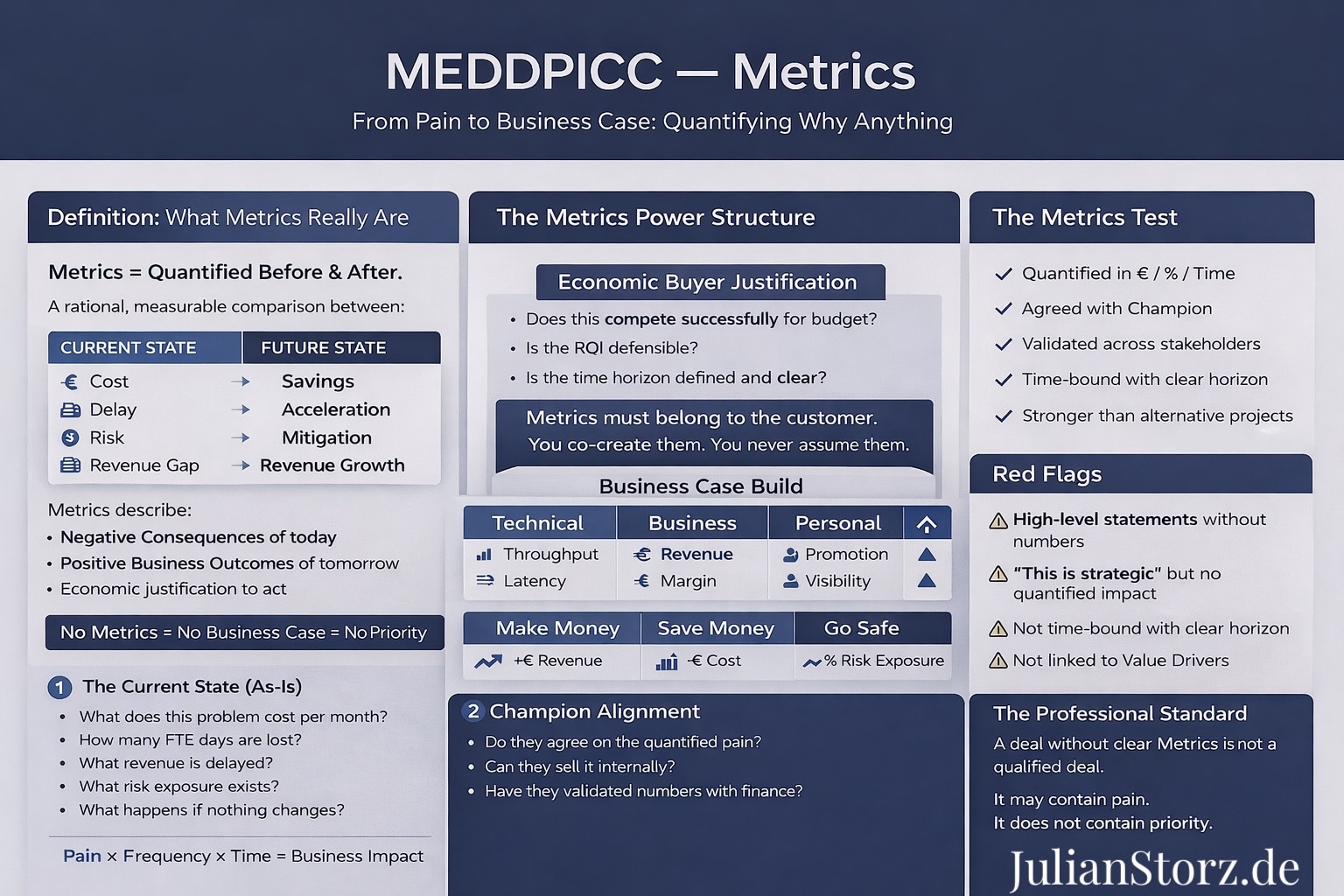
Why Metrics Exist in MEDDPICC
Metrics operationalize “Why Do Anything?” in measurable and defensible terms
Metrics make the situation measurable. Once it is measurable, you and your customer can understand it. Once you understand it, it becomes controllable and possible to be improved. Especially when selling cutting edge solutions – customers are often not aware of the shortcomings of their today’s operations, technology and processes. Which makes it even more important, to quantify the current state and make the “invisible” problems visible.
This is true for a sales leader who tries to improve his sales organization, as it was outlined in the book “The Qualified Sales Leader”, it is also true for any other business context. Measurability also enables comparison: the clearer the benefits and mitigated pains are, the easier it becomes to justify the use of scarce resources for one alternative versus another.
“Measurement is the first step that leads to control and eventually to improvement.
If you can’t measure something, you can’t understand it.
If you can’t understand it, you can’t control it.
If you can’t control it, you can’t improve it.”
— *The Qualified Sales Leader, John McMahon *
The same pattern shows up in deals. Many sellers can find pain. Fewer can quantify it. Very few implicate it enough to create urgency.
“Some salespeople will find pain, but fewer salespeople quantify pain, and only a small minority will ever implicate pain… If salespeople never quantify pain, they can’t justify their price point. If salespeople never implicate pain, they never create urgency… Time kills all deals without urgency.”
— The Qualified Sales Leader
So in MEDDPICC, Metrics help you move from a vague problem to a clear reason to act for the customers decision makers.
Metrics Are Owned by the Customer
Outcomes belong to the business, not to the vendor
Metrics are not “your” numbers. They belong to the customer because they relate to how the customer runs the business.
That is why discovery must connect any problem to:
- a company measure
- a person who is accountable
- and a desired business outcome
“What company measure does this affect? Who is held personally accountable for this measure? … What is the company’s desired business outcome?”
— The Qualified Sales Leader
If you only speak in general terms, the customer cannot defend the value internally.
“You can’t express the value only in general terms, like increased productivity, reduced headcount, quicker time to market, etc. without adding a material measure or a quantified value.”
— The Qualified Sales Leader
Metrics as a Credibility Mechanism Across the Sales Cycle
Metrics help establish credibility before decisions are discussed
In enterprise sales, credibility does not come for free. You often meet people who do not know you yet. Metrics help because they make your claims concrete.
“Credibility matters. And every time we seek to explain ourselves, there are opportunities to use language, information and tone that can increase our credibility there and then.”
— The Art of Explanation, Ros Atkins
This matters most early on. And we will be looking into how you can use Metrics and customer stories in pipeline generation and discovery in the following two segments.
“We may be addressing people who know nothing about us… In these situations, it’s important to think of ways to establish your credibility.”
— The Art of Explanation, Ros Atkins
Metrics also matter for Champion trust.
“Do they trust that the solution will drive measurable impact on business goals?”
— The Qualified Sales Leader
Metrics in Pipeline Generation
Past success metrics support relevance and prioritization
Before discovery, metrics help you earn attention, because they make your message simple to understand, less vague and ambiguous, and less like marketing fluff and more like serious and credible business. They also help you pick the right accounts to focus on, because they help you identify in which industry, in which use cases, and against which competitor your offering provides the highest value in clear, measurable, and comparative terms.
“Customer success stories with quantified before/after metrics, add credibility and therefore build trust in the first interaction”
— Personal Experience
“Reps need to know… 6. Typical quantifiable value of their solution 7. Customer success stories with before and after scenarios.”
— *The Qualified Sales Leader *
The logic is straightforward: start from your differentiators, map them to pains, quantify value, then prioritize where value is highest.
“Create a list of unique and defensible product differentiators… Quantify the business benefits of solving pains in each use case… Discover companies/industries which have those specific uses cases… Prioritize companies and industries based on highest customer value.”
— The Qualified Sales Leader
Metrics in Discovery
Metrics anchor discovery in the customer’s Current State
In discovery, metrics help you avoid vague conversations. The goal is a baseline: what is true today, and what does it cost.
One of the main challenges that inexperienced sellers face is that customers often struggle to verbalize the costs of something. This is often because they themselves lack the experience to break their problem down to first-principle effects. This is also why strategy consultants are paid so handsomely. One of my leaders, Donn D’Arcy, always said that a good seller is as sharp as a McKinsey Consultant with the drive of a hunter.
There is a book called How to Measure Anything. Its central idea is practical: everything is measurable, and almost everything can be translated into monetary terms if you decompose the problem far enough.
A simple decomposition chain can look like this:
Inefficient Process → Time Lost → Machine Time and Human Time Lost → Cost for the equipment linear over lifetime + Maintenance Cost → Total Equipment Operation cost + Full Time Equivalent (Employee) Cost per unit time that was not used productively = Total cost of current ineffective process.
Over three to six steps, you can usually connect even “soft” issues to clearly measurable and comparable metrics.
“What company measure does this effect? Who is held personally accountable for this measure? … How is this issue affecting the company? … What is the company’s desired business outcome?”
— The Qualified Sales Leader
A common practice is to keep asking until you reach a dollar value.
“I do not stop the discovery / asking questions before I end up with a $ value. Always ask, So what? … % are good; $ are better.”
— Notes from my personal diary 2019
Scoping turns those inputs into a shared plan and a shared justification.
“The Scoping journey will generate… 1. A Cost Justification with as-is and to-be metrics 2. A POV Plan… 3. A Preliminary Pricing Proposal which is based upon the preliminary cost justification.”
— The Qualified Sales Leader
If a customer cannot follow through with the impact questions, you have two options. First, you can involve another person who can help answer these questions, because ownership and accountability often sit with someone else. Second, you can educate yourself as a seller, because it is your responsibility to educate and advise the customer so they can find a solution that actually solves the problem.
If you cannot do that honestly, you should walk away.
Two Types of Metrics You Must Qualify
Technical performance implies business impact
Different parts of the organization use different language. Executives focus on a small set of outcomes.
“At the highest levels of an organization, business pain is related to revenue, profitability, and risk.”
— The Qualified Sales Leader
So you need to connect lower-level measures to those outcomes.
“As you move down the organization, the words may change, the measures change, but it is how those measures translate to revenue, profitability, and risk, that gets you above the noise.”
Technical Metrics
Metrics that validate required capabilities
Technical metrics show whether required capabilities can be met and how success will be measured in a validation.
“Reconfirm the as-is and to-be process metrics from the cost justification… Capture material evidence of the solution solving the customer’s pain.”
— The Qualified Sales Leader
Technical control depends on required capabilities, decision criteria, and scope.
“From the technical side: 1) Know and have influenced the required capabilities and Decision Criteria 2) The customer needs to have a fully defined scope… 3) The customer pain can be solved by my offerings.”
— The Qualified Sales Leader
Business Metrics
Metrics that justify investment
Business metrics translate impact into money. This makes prioritization possible. Quantification and implication affect price, urgency, and Champion building.
“Found business pain creates opportunity. Quantified business pain drives higher price points. Implicated business pain drives urgency. Business pain and urgency finds business Champions… You sell big deals based on value.”
— The Qualified Sales Leader
At the executive level, the frame stays the same. It is always about: Revenue, Profitability, Risk and People.
Metrics Must Align to Required Capabilities and Differentiation
Metrics connect pain, capabilities, and vendor selection
Metrics should support “Why us?” by connecting differentiated capabilities to the customer’s pains. Metrics should not appear as a late-stage add-on. Metrics should emerge as the outcome of smart, two-sided discovery questions, which you design backwards from the Required Capabilities that the customer needs to achieve the desired Future State. When you start with Required Capabilities, you can ask discovery questions that surface how the customer will measure success, how they will validate progress, and what “good” looks like in operational terms. Those answers then make differentiation measurable, because they convert “we are better” into comparative proof against explicit success criteria.
“Create a list of unique and defensible product differentiators. Target pain points that the differentiators solve. Map pain points to specific use cases. Quantify the business benefits of solving pains in each use case.”
— The Qualified Sales Leader
“Why do they have to buy from US? 1. Do our product differentiators tie to their pains? 2. Which of our product capabilities is uniquely differentiated?”
— The Qualified Sales Leader
When Metrics Are Qualified in the Sales Process
Metrics evolve as the deal progresses
Metrics start rough and become precise as the deal moves forward. In the first discovery meetings, you will typically identify the pain only. At that stage, you can name what is broken, but you will rarely be able to specify what it costs, what it blocks, and what it prevents.
Over multiple conversations, as you move through the scoping phase of the sales cycle toward the Economic Buyer meeting, the pain becomes indicated and implicated. It becomes connected to impact and negative consequences. Later, it becomes connected to opportunity cost: what the organization is missing out on by staying in the Current State.
In parallel, as competition becomes explicit and as your unique differentiation becomes relevant, metrics also become tied to the Required Capabilities. This completes the picture: pain becomes measurable, success becomes definable, and differentiation becomes comparable against alternatives.
Stages of an Enterprise Software Deal: “1. Discovery 2. Scoping 3. Economic Buyer Meeting 4. Validation Event 5. Business Case and Final Proposal 6. Negotiate and Close”
— The Qualified Sales Leader
Early: Discovery and Pain Implication
Metrics indicate and implicate the problem
Early on, focus on frequency, impact, and ownership.
“When does this occur? How often does this occur? … What company measure does this effect? Who is held personally accountable for this measure? … How is this issue affecting the company?”
— The Qualified Sales Leader
“Found business pain creates opportunity. Quantified business pain drives higher price points. Implicated business pain drives urgency.”
— The Qualified Sales Leader
Mid: Technical and Process Evaluation
Metrics validate feasibility and risk
Mid-cycle, reconfirm baselines and targets and capture evidence.
“Reconfirm the as-is and to-be process metrics from the cost justification… Capture material evidence of the solution solving the customer’s pain.”
— The Qualified Sales Leader
“From the technical side: 1) Know and have influenced the required capabilities and Decision Criteria 2) The customer needs to have a fully defined scope… 3) The customer pain can be solved by my offerings.”
— My Personal Diary
Late: Business Justification and Business Case
Metrics justify budget and priority
Late-stage work is about building and defending the business case, especially with the Economic Buyer.
“Goals of EB Meeting: … 2. The company’s current state. The as-is 3. The negative consequences of that current state 4. Your proposed state. The to-be 5. The benefits of the future state 6. The required capabilities to achieve that future state 7. Customer success stories with quantified before/after metrics…”
— The Qualified Sales Leader
Budget commitment is tested directly.
“Would you be willing to allocate budget? E.g., if we could prove during the Validation Event that we could save your company $X for an investment of $Y, would you allocate $Y budget?”
— The Qualified Sales Leader
Metrics Must Be Captured in Customer Language
Champions must be able to repeat them internally
Metrics must belong to the customer. If the customer cannot repeat the metrics internally, the metrics will not help you. The Economic Buyer relies on the Champion to implement the project. To make a Champion take on the risk to carry that responsibility, and for the Economic Buyer to understand the business justification, the Champion must be enabled to sell internally for you. Therefore, everything that is built must be co-created with and for the customer. Shared language improves qualification and internal selling.
“The team must adopt a common vocabulary for all your sales terminology. It’s fundamental to effective communication and it’s the basis for accurate qualification and rep development.”
— The Qualified Sales Leader
“Can they detail why the identified company pain could be classified as ‘major’? Can they explain the implications of not solving the pain? How do they see that your solution provides business value?”
— The Qualified Sales Leader
Metrics as a Qualification Filter
Metrics reveal deal reality
Good metrics reveal whether a deal is real. Weak metrics often hide gaps in qualification. If there is no clear alignment with the customer, what success looks like, it becomes hard to co-create that solution together.
“If you have deployed it correctly, MEDDICC should act as a map in the late stages of the deal that clearly shows you exactly where you are in your deal, where you have left to go, and any uncovered territory.”
—* Meddicc, Andy Whyte, Dick Dunkel, and Jack Napoli *
“Focus on: … Pipeline Generation… Qualification – Ensure that engagements make sense… I define with the client what success looks like.”
— My Personal Diary
What a Qualified Metric Must Contain
Key attributes derived from discovery and scoping
Metrics span technical metrics and business metrics. They describe the Current State and its Negative Consequences, and they describe the Future State and the resulting Positive Business Outcomes.
Metrics as a Mechanism for Deal Control
Metrics define how success is evaluated
A deal without clear metrics is poorly executed, even if there is real pain. Without metrics, you do not run the deal with the rigor of a real professional. You cut corners. You avoid talking to enough people in the organization. You avoid the discomfort of asking the difficult questions, and you avoid earning the right to ask them.
A sales professional who does not only care about short-term money, but about real customer service, joint success, and a long-term professional career, should not rest on high-level statements. That person should listen not only to answer, but to understand.
Metrics influence how validation is run and how the customer justifies the purchase. So start taking ownership. Do the work, take an honest look at your qualification and build the muscle to listen attentively, emphasize with your customers situation. Understand it deeply and help to find solutions, if you can. Both to fix the problem AND to make it politically possible to alleviate the challenges of your Champion.