
Many discovery calls fail for a simple reason. Sellers confuse activity with progress. They ask questions, but they do not learn enough about the business. They talk about the product too early. They stop at surface pain. They leave with positive signals, but no real buy in from the customer for next steps.
Having shallow discovery and “forcing customers” into the continuous meetings leads to the illusion of a real pipeline, lack of time for pipeline generation, weak qualification, bad forecasts, and a poor customer experience.
That is a serious problem. In complex B2B sales, discovery is not just a step before the demo. It is the stage where you find out whether there is a real business problem, who cares about it, how it is measured, if the opportunity is large enough for you to justify the time investment, and whether there is enough urgency to justify change.
When you run discovery well, almost everything gets better after that. Qualification improves. Stakeholder strategy gets clearer. Value becomes easier to explain. The business case gets stronger. Pricing gets easier to defend. Next steps become easier to control.
In this guide, I will show you how to run discovery calls that do five important things well. It should uncover real business pain rather than just collect requirements. It should connect that pain to metrics the customer cares about. It should create urgency by showing the cost of doing nothing. It should qualify the right stakeholders early. And it should end with a clear advance instead of a polite continuation.
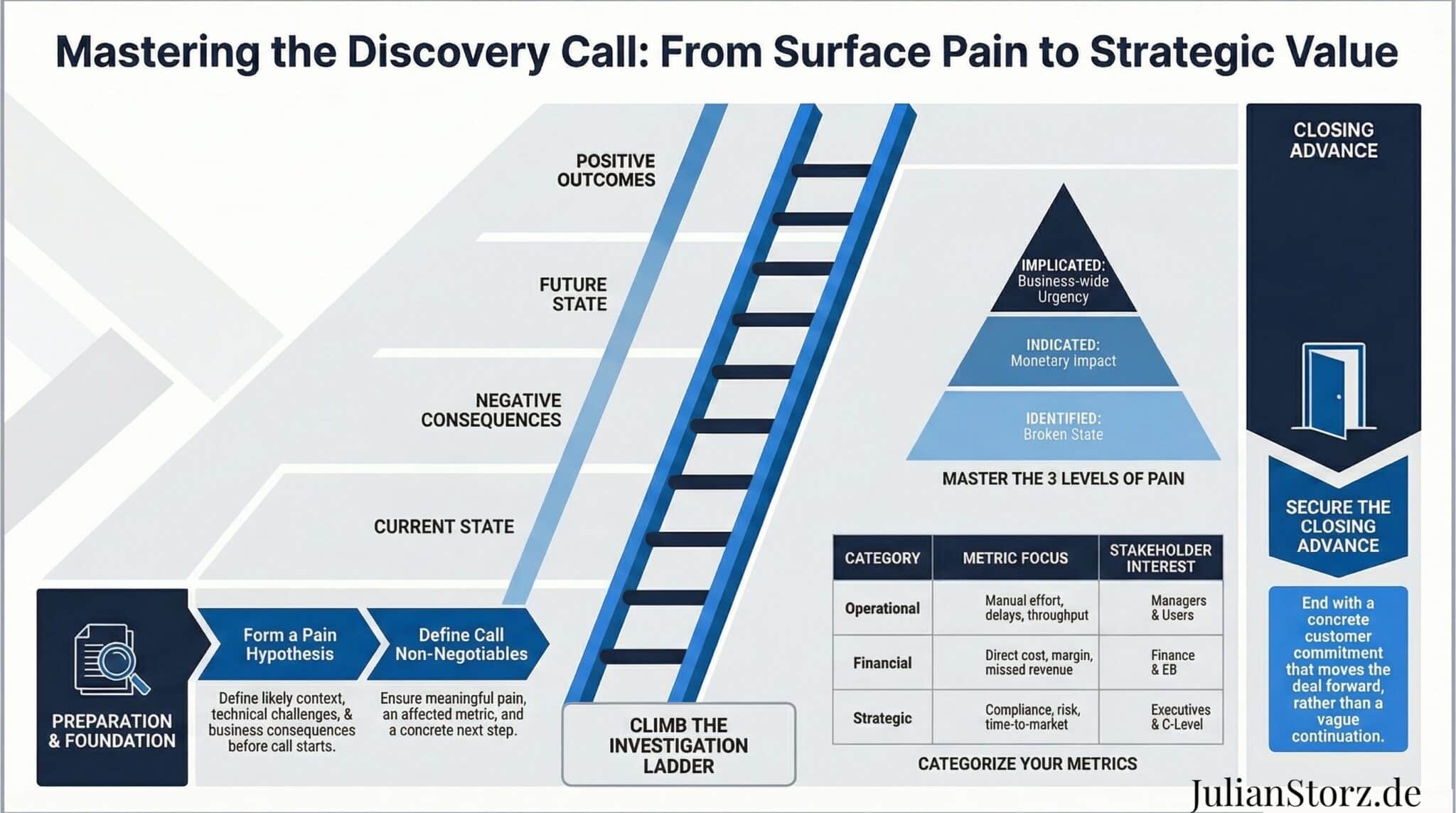
What a Discovery Call Is – and What It Is Not
A discovery call is a structured conversation that helps you understand the customer’s current situation, the problem worth solving, the business impact of that problem, the people involved, and the reasons why change may or may not happen.
At its core, discovery is an investigation. It is not an interrogation. It is not small talk. It is not a hidden demo. It is an honest, focused conversation to understand your customer and what they need to succeed with their goals.
What a discovery call is
A good discovery call helps you answer a small set of important business questions. Instead of treating them as separate boxes to tick, it helps to group them into a simple frame.
| Discovery lens | What you need to understand | Core question |
| Project | The initiative, program, or business problem in focus | What are we actually talking about? |
| Pain | What is broken, limited, delayed, risky, or expensive today, and what happens if it continues | Why does this matter? |
| Future state | What the customer could do differently if the problem did not exist and what additional value that would create | What becomes possible if this is solved well? |
| Metrics | Which business measures are affected today and which ones could improve in the target state | How is this measured now, and how would success be measured later? |
| People | Who owns the problem, who influences it, and who can fund a solution | Who matters in this decision? |
| Timing | Why the issue matters now instead of later | Why act now? |
| Size | What is the size of the project? How much revenue could you generate from it. First high level understanding. | How much time can you invest? |
Discovery vs. Qualification
Qualification helps you decide whether an opportunity deserves time and resources. Discovery gives you the information you need to qualify well.
You cannot answer serious qualification questions such as Why anything? Why now? Why your solution / offering? if you do not understand the business pain, who is affected, which metric suffers, and what happens if the customer does nothing.
Good qualification depends on good discovery. Otherwise, you are qualifying based on hope instead of evidence.
Discovery call vs demo
A demo shows how your solution works. Discovery helps to understand whether the customer has a serious enough problem to care and if/how your solution can solve that problem.
That order matters. In complex sales, showing capabilities too early often hurts the deal. The customer starts to look at features. The conversation drifts into technical details. The real business problem stays underdeveloped. You may create interest, but you do not always create buying motion. This is even more critical, if your solution is very versatile and just comparing features, does not provide the full picture. You need to be able to present and explain your solution in the context of the customer, to make it really impactful.
Discovery should shape the demo, not the other way around.
Why discovery matters
Without strong discovery:
- The pain stays vague
- The metrics stay weak
- Urgency never really forms
- The champion has no story to tell internally
- The economic buyer has no reason to move money
- The next step becomes a continuation instead of an advance
That is why discovery is one of the most important skills in enterprise sales. Often people take it for granted and are not focusing enough on it. Everybody focuses on closing. But with discovery done right; closing becomes easy.
How to Prepare for a Discovery Call
Weak discovery often starts before the call. If you enter the meeting with no point of view, no hypothesis, no stakeholder map, and no clear objective, you force yourself to improvise building the foundation for the sales process in real time. That is avoidable.
Preparation does not mean writing a word-for-word script. It means knowing what you need to learn, what you already suspect, and what success looks like for the call. It also means researching the customer industry, understanding how the solution could look like in their context and have looked into relevant examples for the customer. This is necessary to help bridge the gap between the way they currently do things and understanding how a better solution could look like. Further, it shows them that they are not alone in that journey, what obstacles others had similar to theirs, and how you jointly managed to overcome them.
Specifically for sellers new to a company, take the time to read all case studies that were done in your customer industry in the past. Get deeply familiar with what problems there were, how these were measured, and what outcomes have ultimately been achieved. Use this knowledge until you have your stories to tell. But, make them your own; be in the details. Customers who spend large sums of money for your solution can expect to transact this with an expert, that helps them to mitigate risks and achieve the promised outcomes.
Define the objective of the call
Begin with the end in mind.
Do not use a vague goal such as “have a good conversation” or “learn more.” Define a clear outcome that gives you enough evidence that you can help the customer. A simple way to do that is to think in terms of the specific advance you want to earn.
| Weak objective | Strong objective |
| Learn more about the account | Confirm whether the customer has a serious business problem tied to a real initiative |
| Have a good first meeting | Identify one measurable impact area that could support a business case for your offer |
| Build rapport | Validate the likely champion and test access to other stakeholders |
| Keep momentum | Secure a follow-up meeting with additional business owners |
The objective should be specific enough that you can tell, at the end of the call, whether you achieved it.
Research the account and likely initiative
Before the meeting, gather enough context to sound informed and to ask better questions.
| What to research | Why it matters |
| Company goals and strategic priorities | It helps you connect your questions to something that already matters internally |
| Likely programs or initiatives related to your use case | It helps you anchor the conversation in a real business context |
| Public signs of timeline pressure, launches, cost pressure, compliance pressure, or growth targets | It gives you clues about urgency |
| The roles and likely incentives of the people joining the call | It helps you ask sharper, more relevant follow-up questions |
The goal is not to show off your research. The goal is to ask relevant questions and be knowledgeable from the first few minutes. As a result, a customer will experience you as a trustworthy person and derive value from the conversation with you.
Form a pain hypothesis
Good discovery should not start from zero. Start with a problem statement or a working hypothesis. Based on the account, the use case, and your experience, define what may be happening, who may care, and what business impact may exist.
A useful hypothesis often includes four parts:
- The context or trigger
- The likely technical or operational challenge
- The business consequence
- Who probably cares most
You do not need to be right before the call starts. You just need to avoid asking random questions.
Choose the right value-driver to build your hypothesis
Not every customer defines value in the same way. Some care most about cost. Others care more about speed, productivity, growth, compliance, resilience, customer experience, or strategic risk. This also depends on the overall situation the company or the line of business is in.
Go into the call with a point of view on which value drivers are most likely to matter.
| Value-driver lens | What it usually sounds like in discovery |
| Revenue | growth, conversion, onboarding capacity, retention, upsell |
| Cost | manual effort, waste, inefficient processes, cost to serve |
| Risk | compliance, security, downtime, audit exposure, reputational damage |
| Speed / productivity | delays, slow execution, bottlenecks, low throughput |
That lens helps you ask better questions and make better follow-ups.
Prepare question paths, not a script
A script makes you stiff. A question path makes you ready. Look at the opportunity from a MEDDPICC and Command of the Message lens. What information are you still missing? Based on that plan the broad sequence of the call:
- Opening and context questions
- Current-state questions
- Pain questions
- Consequence questions
- Metrics questions
- Stakeholder questions
- Next-step questions
Then prepare a few strong follow-up questions under each area. Your job is not to read them in order. Your job is to know where to go next when the customer gives you something useful.
Decide what you must leave with
Before the call, define your minimum non-negotiables. For example:
- One meaningful pain worth developing
- At least one affected business metric
- Clarity on who owns or feels the pain most
- A view on whether there is real urgency
- A concrete next step in the calendar
If you do not know what you need to leave with, you will accept too little or don’t set the right focus and get distracted during the call with other interesting but irrelevant topics.
How to Uncover Real Pain and Negative Consequences
This is where most discovery calls break. Many sellers identify a problem, then move on too fast. They hear a symptom, call it pain, and start talking about the future state. That is not enough. Surface pain creates surface urgency. Surface urgency rarely gets a project funded.
Surface pain vs real business pain
This is one of the most important distinctions in discovery. Surface pain names the issue. Real business pain shows why the issue matters.
A more precise way to think about this is through the three levels of pain outlined in more detail here: MEDDICC Pain: identified pain, indicated pain, and implicated pain. The difference is not just depth. The difference is what kind of commercial meaning the customer has attached to the issue.
| Pain level | Definition | What it sounds like |
| Identified pain | The customer describes the problematic current situation. Something is broken, inefficient, frustrating, or below expectations. | Shipments are often not accepted because we cannot provide a precise expected time of arrival. People are not at home when the courier arrives and are unwilling to plan around a four-hour time window. |
| Indicated pain | The identified pain is linked to a specific monetary impact or other clearly measurable cost of the current situation. | As a result, employees need multiple attempts to deliver goods, which increases the cost per delivery. This either reduces margin or raises prices and makes the offering less competitive (Monetary value / % Improvement is the goal). |
| Implicated pain | The conversation expands beyond the current cost and explores the broader implications of not changing, plus what becomes possible if the problem is solved well. | If shipments could be handled more effectively, costs per delivery could fall, storage space could shrink, and more units could be delivered by one employee due to higher ETA reliability. That would raise shipment capacity with fewer staff and improve both employee and customer satisfaction (Monetary value / % Improvement is the goal). |
That difference matters. Buyers do not fund symptoms. They fund outcomes, avoided losses, and achieve better business outcomes based on a solid foundation of a customized business case.
Your job in discovery is to move the conversation from identified pain to indicated pain and then to implicated pain. That usually requires multi-level follow-up questions and sometimes conversations with multiple different stakeholders across different meetings. One question is rarely enough. You often need to ask what is happening, why it is a problem, what it costs today, what else it blocks, what people miss out on because of it, and what the better goal state would make possible.
How to move from symptom to business problem
To deepen pain, move step by step. A simple question ladder keeps the conversation moving without making it feel mechanical.
| Step | Purpose | Example question |
| 1. Current state | Understand what is happening now | What is happening today? How does it work today? |
| 2. Problem | Understand what is problematic about the current state | What is the issue with the current way of doing things? |
| 3. Consequence | Understand what it causes | What happens when that issue occurs? |
| 4. Impact area | Understand what it affects | Which team, process, or outcome does it affect most? |
| 5. Metric | Understand how the business feels it | Which business metric moves because of it? |
| 6. Monetary value or equivalent | Translate impact into economic language | Roughly what does that cost per month, per quarter, or per year? If not money, what target, capacity, delay, or risk level does it change? |
| 7. Broader implication | Understand what else this blocks or limits | What else becomes harder because of this, and what could the business do differently if this constraint disappeared? |
| 8. Urgency | Understand the cost of delay | What happens if nothing changes over the next 6 to 12 months? |
The goal is not only to hear that the problem exists. The goal is to first understand it in an equivalent business measure such as lost capacity, slower execution, increased risk, lower quality, or missed growth, and then translate that into money. This is the only way the value created by your offering can be compared transparently with other options.
How to deepen pain without sounding robotic
The answer is two fold. First be and sound more curious. Second, explain your why, why do you ask the question, why is it important for you to understand to ultimately help the customer. Be open tell them for example: that based on your experience, to justify the cost for an investment, there needs to be a real impact on the business, and then wait for an answer. Use natural prompts such as:
- Tell me more about what happens when that issue shows up.
- Explain how that impacts the team or the business.
- Describe the last time this caused a serious problem.
- Walk me through what the downstream effect looks like.
- Help me understand why that matters now.
Listen properly. Discovery gets better when the seller talks less, not more.
How to uncover negative consequences of inaction
Pain becomes commercially useful when you expose the cost of leaving the current state in place. Useful consequence questions include:
- What happens if this stays the same for another year?
- Which business target becomes harder to hit?
- What does that delay, cost, or risk in practical terms?
- Who feels the pain most when this goes wrong?
- If nothing changes, what are you likely forced to keep doing manually or inefficiently?
The goal is clarity. Could you explain it easily to someone who is not familiar with the matter? Would you act based on this information, if you were in the customer’s situation and needed to decide with your money?
How to test whether the pain is big enough to fund change
Not all pain deserves a project. You need to test whether the issue is serious enough to justify money, time, attention, and stakeholder effort. Ask yourself and the customer:
- Is this a top-priority issue or just an annoying inefficiency?
- Does it affect a metric that senior leaders actually care about?
- Is there a timeline or event that makes delay costly?
- Would an economic buyer move budget to solve it? (You can qualify this by identifying the potential EB and then probing this question with multiple people within his or her reporting line)
- Is the current state painful enough that doing nothing is no longer acceptable?
If the answer stays weak, keep your standards high. Interesting is not enough. Explain this to the customer, conduct negative selling, and see if you get pushback. If there is value for the customer that you do not see, which the customer now explains it to you; or if they agree and you both move on with your lives.
The Best Discovery Questions by Stage of the Conversation
The best discovery questions are not the most creative ones. They are the ones that move the conversation from context to consequence to commitment. Instead of thinking about this as a long list, it is easier to think about it as a flow.
| Stage of the conversation | What you are trying to learn | Useful question examples |
| Opening | Why the meeting exists and how the issue connects to something bigger | What prompted you to take this conversation now? • What do you want to get out of the next 30 minutes, such that this was the most valuable meeting of your week? • What would make this discussion useful for you today? |
| Current state | How the customer works today and where the process starts to break Go into the details here! Deep understanding gives you the right to go into pain. | Can you walk me through the current process? • Who is involved today? • Where does the current approach work reasonably well, and where does it break? • How does this initiative connect to the broader priorities of the business? |
| Pain | Why the issue matters beyond inconvenience | Why is that a problem for the business? • What are the disadvantages of doing it this way today? • What has become harder because of this? |
| Consequence | What happens downstream and what the business loses | What happens downstream when that occurs? • Which business metric suffers most because of this? • Who is held accountable for that outcome? |
| Metrics | How the pain shows up in measurable terms | Ballpark, how much time does the team spend on this today? • If you had to estimate the annual cost of this issue, what range would you use? • Which KPI would improve if this problem went away? |
| Stakeholders | Who feels the pain and who can move the deal | Who is most affected by this day to day? • Who owns the result that this problem damages? • Who normally approves projects of this size? |
| Commitment | Whether the issue is serious enough to pursue | Based on what we have discussed, how high does this rank internally? • If we could make the impact clear, would this be important enough to move forward? |
| Next step | What concrete action should happen next | Based on today’s conversation, I suggest that we… • Who else should be part of that next conversation? |
This matters because discovery is not just about asking good questions one by one. It is about asking the right kind of question at the right moment. While maintaining dialog and building trust.
How to Run a Discovery Call in 30 Minutes
Thirty minutes is enough to create progress. It is not enough to solve everything, and this is the common issue. Sellers try to get everything done in a rush rather than take time to understand the problem and help solve it. To be able to use the time and create value, you need discipline, to know what would be meaningful for both sides, what the reasonable next step could be, and to be disciplined with time.
What must be covered
In a short discovery call, you cannot cover everything. You need to cover the right things.
| Must-have area | Why it matters |
| Context and Initiative | It tells you what the conversation is really about |
| Clear understanding of the way the customer currently operates | It allows you to also review in hindsight with experts, what value you can deliver that you have potentially missed. |
| One or two meaningful pains | It gives the meeting commercial substance |
| The consequence of those pains | It creates urgency and priority |
| Who is involved and who matters | It shows whether the opportunity can move |
| The next step | It turns a conversation into progress |
A practical 30-minute structure
A useful structure looks like this:
| Time | Focus | What you do |
| 0-5 min | Frame the meeting | Confirm purpose, align on agenda, show that you understand the context, and set expectations for how the time will be used |
| 5-20 min | Investigate | Explore current state, pain, consequences, metrics, and stakeholders, while also sharing relevant patterns from similar situations, common consequences others faced, and how strong teams solved them. Discovery should feel like mutual value creation, not a one-sided interrogation. Educate the customer about what they do not know / see and how this can help them create value. |
| 20-25 min | Validate and sharpen | Summarize what you heard, test whether the issue is important enough, and clarify missing information. |
| 25-30 min | Secure the advance | Propose the right next step, define who should join, and get the meeting or action agreed upon before the call ends |
Most of the time should go into investigation. That is the part many sellers shortchange, even though it creates most of the value.
What to skip
Skip anything that feels productive but does not improve business understanding.
Usually that means:
- A full product demo
- Deep technical architecture discussion
- Feature tours
- Long company presentations
- Solution design before the business problem is clear
How to manage time without sounding rigid
Set the frame early. For example:
My goal for the next 30 minutes is to jointly understand what matters most to you, if and where you currently see challenges to get an understanding of if and how we can help. At the same time, I have prepared some insights on challenges we typically see and how these can be solved. If this is relevant to you, I am happy to share. At the end of the conversation, we can see whether there is enough value for both sides to continue. If we see that there is, we can decide together what the most useful next step should be.
That makes you look structured and professional, not mechanical. As usual, it depends on the how you deliver it at least as much as the what. So make sure to be natural and sincere about it.
How to leave with a real next step
At the end of the call, ask yourself one hard question: Did the customer commit to an action that advances the deal?
A real advance might be:
- A follow-up meeting with additional stakeholders
- Access to data or metrics for a business case
- A scoping workshop
- An introduction to the economic buyer
- Agreement to validate the impact with a broader team
A vague “let’s stay in touch” or “can you please send me some additional information?” is not progress.
How to Get Metrics Without Sounding Interrogative
Metrics matter because they turn a story into a case. Without metrics, pain stays qualitative. With metrics, pain becomes comparable, easier to defend, and easier to fund.
Why metrics matter
Metrics help you do four things at once.
| What metrics do | Why it matters |
| Connect pain to economic value | It turns a complaint into a business case |
| Justify budget and pricing | It gives the customer a reason to spend money |
| Build urgency through the cost of inaction | It shows what delay is really costing |
| Prepare your champion to sell internally | It gives them a language other stakeholders will respect |
If you do not know how success is measured, you do not understand the opportunity well enough yet.
How to ask naturally
Do not suddenly switch into accountant mode. Let metrics come out naturally during the conversation (Pro Tip – become comfortable talking about money and business in all areas of your life to make it sound more natural. Read business related material and listen to podcasts to give you insights on how business leaders really think; this will help you realize that it is the most normal thing on the planet).
Also use low-pressure language and go into the details over time once trust is built:
- Roughly how big is this issue today?
- Ballpark, how much time does that consume?
- If you had to estimate the annual impact, what range would you use?
- How is that measured internally?
- If that improved meaningfully, what would change for the business?
An estimate is fine at this stage. Precision can come later.
What to do when the customer / prosepct does not know the numbers
That is common. Do not treat it as failure.
Instead:
- Break the number into drivers they do know
- Ask about frequency, headcount, time spent, delay duration, penalty exposure, throughput, or missed revenue
- Estimate ranges together
- Propose a follow-up assessment to gather the missing data properly
Many good champions do not know all the numbers from memory. They need to collect them internally. That is often part of the sales process, not a reason to quit.
How to quantify operational, financial, strategic impact and risk
The easiest way to stay clear here is to group impact into three buckets.
| Impact type | Typical examples |
| Operational | hours spent, manual effort, delays, throughput constraints, rework, productivity loss |
| Financial | direct cost, margin erosion, missed revenue, penalties, infrastructure waste, cost to serve |
| Strategic | slower execution of key initiatives, compliance exposure, worse customer experience, reputational risk, reduced ability to compete |
| Risk | fines and administrative or even legal actions that are the result of noncompliance |
The right metric depends on what the customer actually values.
How to connect metrics to urgency and business case
A metric becomes more powerful when you pair it with time.
For example:
- If this costs you roughly EUR 50k per month, what does another 12 months of delay mean?
- If the team spends hundreds of days a year on low-value work, what else could that capacity be doing?
- If the deadline is missed, what happens commercially or operationally?
That is how you move from numbers to urgency.
How to Keep Discovery Business-Focused, Not Technical
For many sellers, technical discovery feels easier. It is concrete. It feels safe. It creates the illusion of progress. But in complex sales, technical detail without business context rarely moves executive decisions.
Why technical discovery often derails the deal
Technical conversations become a trap when they pull the discussion away from business value.
| What goes wrong | Why it hurts the deal |
| They absorb the limited time of early meetings | You never build enough business depth |
| They keep you too low in the organization | Senior stakeholders stay uninvolved and uninterested in the gathered technical information |
| They create feature appetite without urgency | Interest grows, but commitment does not |
| They make the problem sound local instead of strategic | The issue feels smaller than it really is |
| They encourage solutioning before the case for change exists | The customer evaluates features before deciding whether to act |
Technical depth matters. But it should support the business case, not replace it.
How to redirect technical detail toward business impact
When a technical topic comes up, acknowledge it and bridge back to business relevance. Examples:
- That is useful context. What problem does that create for the business?
- How does that limitation show up in team performance or customer outcomes?
- When that issue occurs, what KPI or process suffers most?
- Which part of the organization feels that impact most strongly?
The bridge matters more than the exact wording.
How to translate technical pain into executive language
Executives do not buy latency, flexibility, or architectural elegance in the abstract. They buy what those things do to revenue, cost, speed, risk, and competitiveness. Translate accordingly:
- Latency becomes conversion loss or customer friction
- Manual workarounds become operating cost and lost capacity
- Inflexible systems become slower time to market
- Weak controls become compliance and risk exposure
The same problem should sound different at different levels of the organization.
How to avoid premature solutioning
Do not rush to answer every early question with product detail. Instead:
- Clarify the problem first
- Confirm the consequence
- Understand what success would look like
- Identify required capabilities only after the need is clear
- Then show only what supports that specific story
That is how you keep credibility without turning discovery into a demo.
How to Qualify Stakeholders: Champion, Coach, Economic Buyer
Strong discovery does not just uncover pain. It also shows whether the deal has a path forward.
Why stakeholder quality is a discovery issue
A good problem in the wrong part of the organization is still a weak opportunity. You need to learn:
- Who suffers from the pain
- Who is accountable for the metric
- Who can build internal support
- Who owns budget or final approval
Discovery therefore has to qualify stakeholder quality, not just problem quality.
How to tell a coach from a champion
A coach helps. A champion moves. The clearest way to see the difference is to compare what each person actually does.
| Likely coach | Likely champion |
| Shares useful information | Sees the business problem clearly |
| Is positive about your solution | Understands what happens if the problem is not solved |
| Helps you understand the environment | Can explain why change matters now |
| Often lacks enough influence to change the deal materially | Helps you access other stakeholders |
| May support the conversation informally | Does work on your behalf and spends political capital |
If you want a deeper breakdown, read my articles on the Champion and the Economic Buyer.
How to test for influence and access
Do not guess. Test it. Useful questions and asks include:
- How are decisions like this usually made here?
- Who made the last major purchase in this area?
- Who else needs to believe this matters?
- Would you be willing to bring in that stakeholder?
- Could we align on a session with the broader team next?
Real influence tends to show up in access and action.
How to identify the economic buyer early
You do not need a full economic buyer meeting in the first conversation. But you do need to understand who that person is likely to be and how budget decisions happen.
Look for:
- Who owns the budget
- Who approves projects of this size
- Which priorities compete for funding
- What proof that person will require
- Who the economic buyer listens to internally
That changes how you run the rest of the process.
How to avoid single-threading
One relationship is not a strategy. From the first discovery call, look for ways to widen the conversation:
- Ask who else is affected
- Invite related stakeholders into the next step
- Separate technical, business, and executive perspectives when needed
- Make stakeholder expansion part of your exit criteria from early discovery
Deals become more real when they become broader.
How to Disqualify Fast and Protect Time
Good discovery is not about proving that every meeting should continue. It is about learning where time deserves to go.
Why disqualification is part of good discovery
A serious seller does not chase every interested prospect. A serious seller protects time, forecast quality, and company resources. That means discovery must also disqualify.
Early signs that the opportunity is weak
Weak deals usually do not fail because of one single signal. They fail because several weak signals appear together.
| Warning sign | What it usually means |
| No clear problem beyond curiosity | The customer may be browsing, not buying |
| No measurable consequence | The issue may not be important enough to fund |
| No urgency or timeline pressure | Delay may carry little cost |
| No access beyond a single low-influence contact | The deal may be trapped too low in the org |
| Resistance to involving others | Internal support may be weak |
| No willingness to estimate impact | The business case may never become real |
| Repeated interest in demos without business discussion | The conversation may stay in solution-shopping mode |
Not every weak sign kills a deal. But several together should change your posture.
How to test seriousness
The cleanest seriousness test is effort.
Ask for something that requires action:
- Stakeholder access
- Internal data gathering
- A workshop
- A follow-up with a broader team
- A meeting with the budget owner
People who want change usually do some work to pursue it.
Curiosity vs buying intent
Curiosity sounds like this:
- Show me what the product can do.
- Send me more information.
- This is interesting.
Buying intent looks different:
- We need to fix this.
- We should involve X.
- We need to understand the impact.
- Let us get the right people together.
- We should validate whether this is worth funding.
Do not confuse polite engagement with commercial momentum.
When to stop chasing
If the customer will not deepen the conversation, will not quantify impact, will not widen access, and will not commit to a concrete next step, you are probably in a continuation. At that point, reduce energy or pause. No deal is often better than false pipeline.
How to Close Discovery with a Clear Next Step
The quality of a discovery call shows up in how it ends.
Why vague endings kill momentum
Most decisions happen when you are not in the room. If your customer leaves the call without a clear summary, a clear next action, and a clear reason to continue, momentum fades quickly. That is why strong discovery closes with structure.
How to summarize in the customer’s language
At the end of the call, recap four things. This is one of the easiest ways to make the conversation feel clear and valuable.
| Summary element | What to cover |
| Current state | What is happening today |
| Negative consequences | Where the business is getting hurt |
| Desired future state | What better would look like |
| Likely next step | What should happen next |
Use their words, not your internal jargon.
A simple structure sounds like this: Here is what I heard about the current situation. Here is where it seems to be hurting the business. Here is what success appears to look like. Here is what I believe the next logical step should be.
That summary helps the customer think, align internally, and correct you if needed.
How to confirm pain, impact, and stakeholders
Ask directly:
- Did I capture that accurately?
- Is there anything important we missed?
- Did we identify the right areas of impact?
- Are there other stakeholders we should consider at this stage?
Do not assume accuracy. Confirm it.
How to propose the right next step
Your next step should fit the maturity of the opportunity. Possible next steps include:
- A broader discovery session with business and technical stakeholders
- A workshop to validate metrics and scope
- An assessment to gather required data
- A focused session on required capabilities
- An introduction or summary review with the economic buyer
The right next step is specific, relevant, and time-bound.
How to get commitment before the call ends
Do not end with “I will follow up and we will see.” Instead, ask for commitment while you still have the customer. Examples:
- Would it make sense to get that session in the calendar now?
- Are you comfortable bringing in the operations lead for the next discussion?
- If I send a short recap and proposed agenda, can we align on a workshop next week on Tuesday afternoon? For me either 14:00 or 16:30 would still work.
A concrete customer action is the standard. Nice language is not.
Final Reminder
You do not need to get everything done in one call. You need to understand whether this is a good investment of time for both sides and align on the right next step to go deeper.