
Definition of Competition
In MEDDPICC, competition is not limited to vendors offering a similar product. Competition is anything that competes for the same customer resources: time, money, and executive attention.
This definition, taken from MEDDICC by Andy Whyte, Dick Dunkel, and Jack Napoli, deliberately expands the scope beyond products and vendors. It forces sellers to understand competition as a political and organizational reality, not a feature comparison exercise:
“Political: Who is your competition? Are they known to you? How were they engaged? Before you? At the same time? What were the circumstances of their engagement? Do they have a Champion?”
— MEDDICC, Andy Whyte, Dick Dunkel, Jack Napoli
Competition in MEDDPICC is therefore not only technical. It is political, temporal, and relational.
What Competition Really Is
Based on this definition, competition typically falls into four categories:
- Other vendors
- Customer building an internal solution
- Changing priorities or reallocation of resources
- Doing nothing and living with the current state
From a handling perspective, these collapse into two fundamentally different competitive situations:
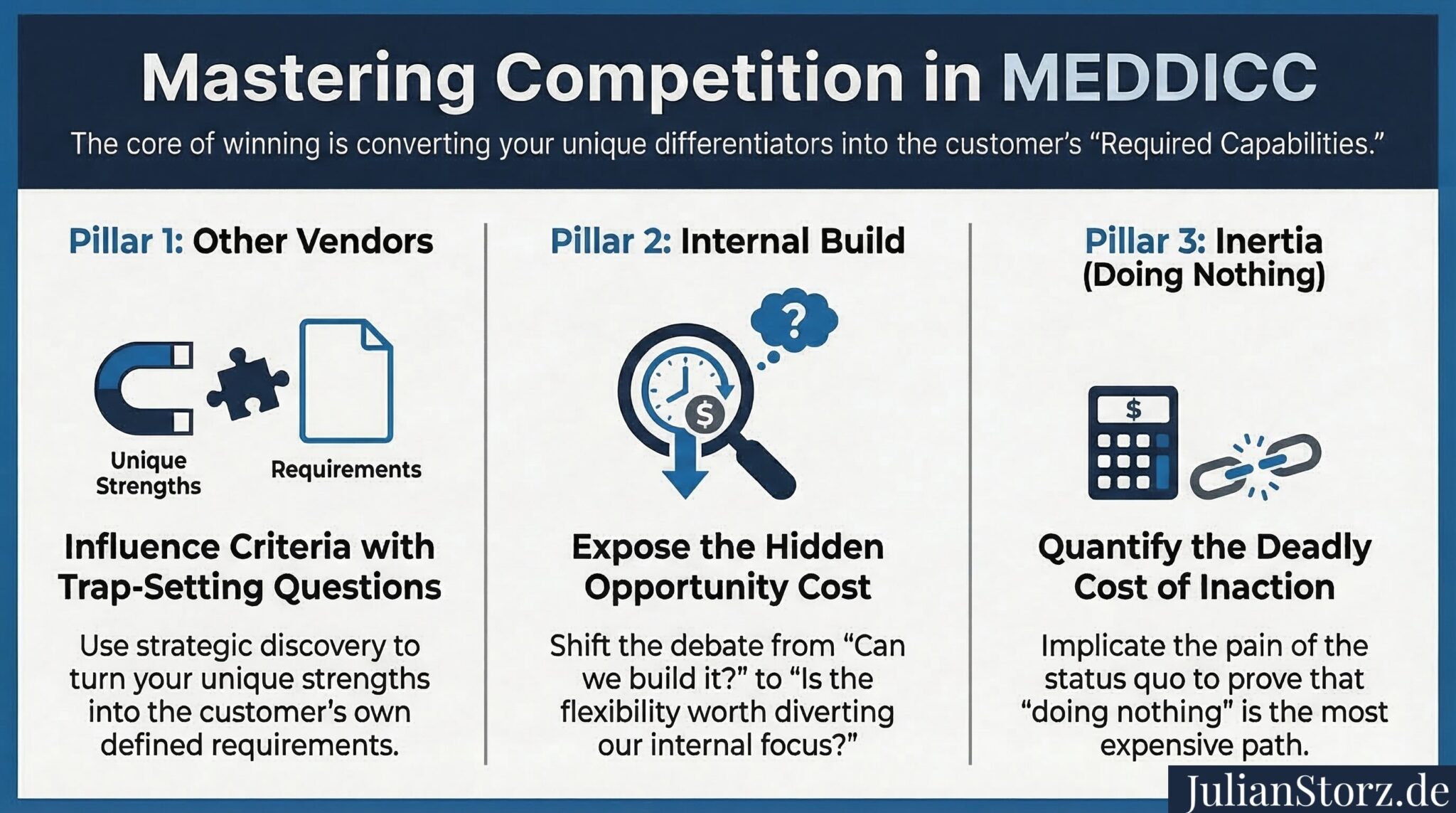
- Other Vendors & Customer Build
- Changing Priorities & Doing Nothing
The second category is often underestimated and closely tied to insufficiently developed pain.
If pain is only identified but not implicated, inaction will almost always win.
This dynamic is explored in more detail in my article on identified, indicated, and implicated pain in MEDDICC:
https://julianstorz.de/sales/meddicc-identified-indicated-implicated-pain/
When Competition Must Be Identified
Competition must be identified in the very first discovery conversations or during the initial customer workshops in which the customer requirements, constraints, and success criteria are defined and jointly documented. At this stage, the customer is not evaluating solutions. They are defining:
- what is broken,
- why it matters,
- and what a valid solution must be capable of.
This is the last point at which competition and it’s perception compared to you and your offering can still be shaped rather than reacted to. Once you begin:
- quantifying ROI or TCO,
- building a business case, or
- discussing investment justification,
Competition must already be explicitly known and modeled.
A business case is, by definition, a comparison of alternatives.
If those alternatives are unclear, the business case is structurally weak.
Competitive Situation 1: Other Vendors & Customer Build
Principle
Competing against vendors or internal builds is not about comparison. It is about value articulation, metrics, and decision criteria. This is why negative selling fails structurally.
David Ogilvy captured this precisely: “Try to avoid being drawn into discussing competitors as it introduces a negative and defensive atmosphere. Never sling mud as it reflects back on you”
The objective is not to prove others wrong. The objective is to make your value and how it is differentiated uniquely unmistakably clear.
Differentiation Through Required Capabilities
Differentiation only matters when it is tied to customer pain and measurable outcomes. This again links directly to how pain is developed and escalated. Without implicated pain, differentiators remain theoretical.
John McMahon provides the operational logic:
“Create a list of unique and defensible product differentiators…
Map pain points to use cases…
Quantify the business benefits…
List the negative consequences of not solving the pain.”
— The Qualified Sales Leader, John McMahon
In practice, this is best executed through trap-setting questions that convert differentiators into the customers required capabilities: To think about them and phrase them correctly – focus on open ended questions and think with the end in mind. The following structure can help you to define them:
“Relevant Defensible Differentiator → Target Required Capability → Trap-Setting Question”
Once a capability has been defined by the customer as required, competitors must meet it or be eliminated by the customer themselves. Here it is critical to stress, that the key always is to attach value to a requirement. And prioritize these requirements together with the customer. Only in this way can you build an edge against your competition.
Build vs. Buy Is a Decision-Criteria Question
Building internally is not ideological. It is one input into the decision criteria. Building offers control and flexibility. It also consumes time, resources, and focus. The relevant question is not “Can you build this?” It is “Is the flexibility worth the opportunity cost?”
That opportunity cost becomes visible only when pain and consequences are fully articulated. Which has to be the outcome of well run discovery and customer workshops.
Competitive Situation 2: Changing Priorities & Doing Nothing
The Real Enemy: Inertia
The biggest competitor in enterprise sales is not another vendor. It is no decision. This outcome is almost always the result of:
- weakly developed pain,
- unclear success criteria,
- or missing executive sponsorship.
Dixon and Adamson refer to this state as “no-decision land”.
— The Challenger Sale
The Critical Question: Who Are You Competing Against?
This question must be answered early. If the customer claims “we are not looking at anyone else”, one of two things is true:
- the initiative is not a priority, or
- you have not identified a real Champion.
A credible Champion:
- understands internal politics,
- knows which alternatives are being considered,
- and can explain what could derail the deal.
This is discussed in depth in my article on the Champion in MEDDICC:
https://julianstorz.de/sales/meddicc-champion/
Without a Champion, competition remains opaque by definition.
Economic Buyer Access and Competition
Competition cannot be fully understood without Economic Buyer (EB) access. If you cannot validate:
- priority
- funding logic
- and urgency
with the EB, competition is being evaluated somewhere else, without you. Lack of EB access is therefore not a procedural issue. It is a competitive risk signal.
This relationship between priority, competition, and EB access is covered in detail here:
https://julianstorz.de/sales/meddicc-economic-buyer/
Value, Price, and Commercial Differentiation
Price only becomes an issue when value is unclear. Neil Rackham stated it directly:
“The building of perceived value is probably the single most important selling skill in larger sales.”
— SPIN Selling, Neil Rackham
A strong business case becomes a competitive weapon only when it explicitly compares:
- your solution
- alternative vendors
- internal build
- and the cost of doing nothing
Without this comparison, price discussions are inevitable. The critical element for any business case is to link price to value for the customer. It has to be in their language and optimally validated and co-created with all relevant stakeholders who are involved in the decision making process.
A great business case always answers the 3 Whys in form of an executive summary: Why Anything (Why Change), Why With You and Your Solution, Why Now.
The section about your solution should be build on the unique differentiators of your solution and the resulting value, not on the shortcomings of the compeition.
Handling Competition by Teaching
The most effective way to handle competition is to help the customer understand their own decision better than anyone else. This is Challenger selling at its core: teaching the customer how to think about the problem, the alternatives, and the decision.
— The Challenger Sale, Dixon and Adamson
Doing this consistently requires Command of the Message: the ability to frame your solution in a way that differentiates and justifies premium outcomes.
Long-Term Strategy: Institutionalizing Competitive Learning
Competition should not be handled ad hoc. You need to learn and understand the competitive landscape deeply over time. Therefore, you should document wins and losses. Review them periodically in a systematic way and ensure that you learn all the nuances personally and together with your sales / ecosystem teams.
Competitive understanding compounds over time, just like pipeline quality. And the better your understanding of your solutions competitive value, the more trust you will build with customers, as you are becoming a real trusted advisor in solving their challenges in a uniquely differentiated way.