
I love Command of the Message®. It has helped me improve the quality of my discovery, sharpen how I communicate with customers, and coach reps more effectively toward greater confidence, better performance, and, in some cases, leadership roles.
Before going further, one point matters. I do not like taking credit for ideas or frameworks I did not create. I would rather be clear about where they come from, apply them well, and help more people learn from them.
Command of the Message® is Force Management’s intellectual property and formal methodology. This article is my practical interpretation of the framework, based on how I have learned and applied similar ideas in complex B2B sales. The goal is simple: help sellers understand the basics well enough that they can start using them in real customer conversations. It is not meant to replace Force Management training.
Force Management describes Command of the Message® as being audible-ready. In simple terms, that means being ready to explain your solution in a way that connects to the customer’s problem, clearly shows why you are different, and supports premium value. That idea matters because strong sellers do not win only because they know their product well. They win because they can adapt their message during a live conversation while keeping the deal focused on the customer’s business problem.
For me, that is the heart of the framework. It is not about sounding polished. It is about being prepared enough that you can think clearly under pressure.
Why Command of the Message matters
Many sellers lose deals before the real evaluation even begins.
They lose because they sound like everyone else. They lead with product. They stay too low in the organization. They accept the customer’s framing instead of shaping it. They talk about features before they build a clear business reason to change.
That becomes dangerous in competitive deals. If the customer does not clearly understand the problem, the cost of doing nothing, and the value of solving it, then every vendor starts to look similar. Once that happens, price becomes more important and differentiation becomes weaker.
That is why messaging matters so much. Good messaging does not just make you sound better. It helps you guide the customer’s thinking. It helps you shape what the customer sees as important. It helps you connect your solution to business value, not just technical capability.
I learned this the hard way. Early in my career (I started my tech-career in Pre-Sales), I thought strong selling meant knowing the product better than everyone else. Product knowledge still matters, but on its own it is not enough. Senior decision-makers move money because of business problems, risk, timing, and measurable outcomes. If you cannot speak to those things, you usually get pushed lower in the organization.
A simple rule applies here: we get delegated to who we sound like. If you sound tactical, you will stay tactical. If you sound commercial and strategic, you are more likely to earn access to stronger stakeholders.
What Command of the Message actually is
At its core, Command of the Message is a way to run a value-based conversation. It is not just an elevator pitch. It is not a deck. It is not a slogan. It is a structure for helping a customer move from their current state to a better future state, while linking that journey to required capabilities, metrics, differentiation, and proof.
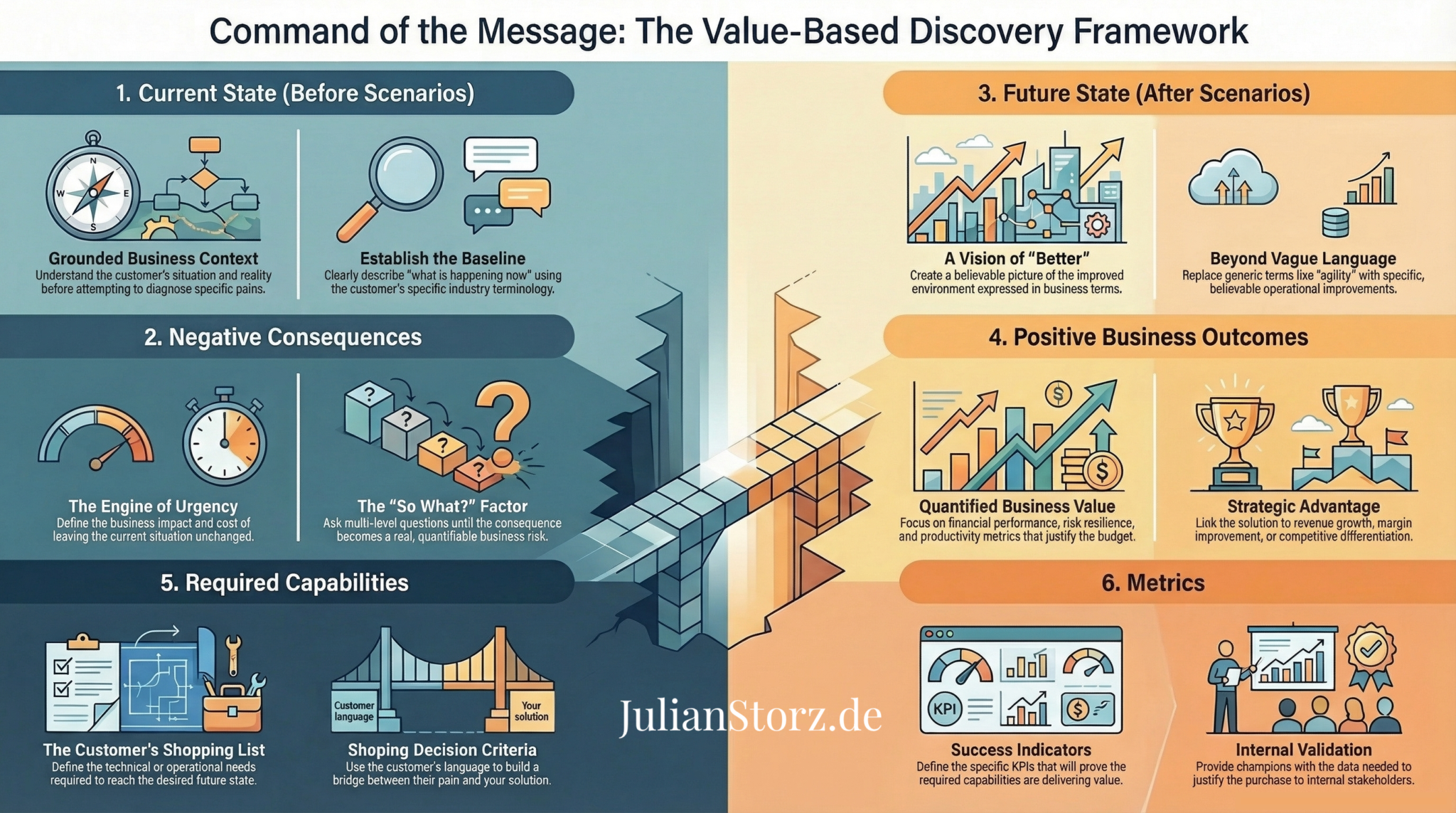
A useful way to think about the structure is as a value-based conversation that moves in a clear sequence:
- before scenarios
- negative consequences
- after scenarios
- positive business outcomes
- required capabilities
- metrics
- how we do it
- how we do it better
- proof points
- discovery and trap-setting questions
That sequence matters because it follows the way strong commercial logic should develop. First, the customer needs to see the current problem clearly. Then they need to understand the cost of leaving it unchanged. Only after that does it make sense to define a better future state, the capabilities required to reach it, and the reasons your approach is the right fit.
Many sellers think Command of the Message starts when they begin to talk about their solution. It does not. It starts earlier, when they help the customer understand the problem in a sharper and more useful way. If you do that well, you are already shaping the deal.
Force Management makes a similar point in public: the person who owns the problem owns the customer. That is important because customers often understand their symptoms better than they understand the full cost of those symptoms. A strong seller helps them make that cost visible and teaches them about unknown solutions and the related business benefits. This also includes secondary and tertiary effects of making a change.
The standard to hit: becoming audible-ready
“Audible-ready” sounds simple, but it is harder than it looks. In practice, it means you can adapt your message to the customer, the situation, and the stakeholder in front of you without losing the commercial thread. You do not need a script. But you also do not drift into random product talk. You know the use case, the pain, the value drivers, the metrics, the proof points, and the reasons you are different well enough that you can adjust in real time.
That is what separates memorization from mastery.
A memorized pitch works only when the conversation stays predictable. Real customer conversations rarely do. Stakeholders interrupt. Priorities change. New information appears. Someone challenge your assumptions. A seller with real command of the message can adjust and still keep the conversation focused on value.
That is why I think of this as a field skill, not as a wording exercise.
A good test is simple: if the customer suddenly changes direction, can you still explain the problem, the stakes, and the reason to act? Or do you fall back into generic product language? If you do the second, you do not yet own the message.
Start with the customer’s value drivers
A strong message starts with a reason to change. At the executive level, value drivers are usually broader and more specific than a few simple labels. Most business priorities fit into a small number of recurring themes:
- Financial performance
- revenue growth through new business, expansion, or retention
- margin improvement and cost reduction
- capital efficiency, including cash flow, working capital, ROI, and ROIC
- Risk and resilience
- lower operational risk such as outages, errors, and compliance failures
- lower strategic risk from disruption or competitive pressure
- stronger security, regulatory, and reputational protection
- Productivity and execution
- more output per head or per unit of spend
- faster cycle times, including time-to-market, time-to-revenue, and time-to-decision
- more reliable and predictable operations
- Strategic advantage
- a more differentiated customer experience
- access to new markets or segments
- data, insights, and capabilities that competitors do not have
- People and organization
- attracting, retaining, and enabling strong talent
- better alignment and focus on a small number of core priorities
- a culture that supports performance and change
- Personal success metrics
- hitting board, owner, or leadership targets and OKRs
- reducing career risk by avoiding visible failures
- building a legacy through transformation, growth, or turnaround
These categories are useful because they force the seller to anchor the conversation in what actually drives executive attention. Customers do not buy because your company wants pipeline. They buy because something material in their business needs to improve, something important needs protection, or someone senior needs to deliver a visible result.
This way of thinking also connects well to Challenger-style teaching about economic drivers. Once you understand the main value driver behind a deal, your discovery gets sharper. Your examples get sharper. Your proof points get sharper. Your stakeholder strategy gets sharper.
A common mistake is to stay too high level. A seller says, “This is about risk reduction,” and stops there. But that is not enough. What kind of risk? For whom? Over what time period? What happens if the risk becomes real? Until those questions are answered, the value driver is still too vague to guide a deal.
The backbone of the conversation: current state, future state, required capabilities, and metrics
This is where the framework becomes practical.
Current state: before scenarios and negative consequences
Most discovery stops too early. A key mistake I have seen over and over again is that reps jump into pain too early. They start digging and probing before they have properly understood the customer’s situation, business context, and real challenges. That usually backfires. It is similar to going to a doctor after coughing once and being told you have cancer. You would not trust that diagnosis, and you would almost certainly get a second opinion. The same dynamic exists in sales. If a rep rushes to diagnose pain before they have truly listened and built a clear perspective on the customer’s world, the questions feel forced, shallow, or premature. Strong sellers do the opposite. First, they listen carefully. Then they work to understand the customer’s situation well enough to form a grounded view of what may matter. Only after that do they go deeper on pain, implications, and consequences. That sequence matters because better pain questions depend on business understanding. Without that understanding, it becomes almost impossible to explore implications in a way that feels credible, useful. and trustworthy
A strong current state has two parts:
- the before scenario, which describes what is happening now
- the negative consequence, which explains what goes wrong if that situation continues
That second part matters a lot. It is where urgency begins.
This same lesson appears across strong sales teaching: sellers must ask second-, third-, and fourth-level questions until the consequence becomes clear. This is where “So what?” matters. You keep asking until the business impact becomes real.
A related mistake happens next: once sellers hear a plausible problem, they move too quickly toward solutions and future-state language. That feels positive and constructive, but it often weakens urgency. If the customer has not fully understood the cost of the current state, the case for change stays soft. In real deals, this happens often. A seller identifies an issue, but never goes deep enough to understand its commercial consequence. They know the issue, but they do not know the cost of the issue.
Future state: after scenarios and positive business outcomes
Once the current state is clear, you earn the right to discuss the future state. A strong future state is not just the opposite of the current pain. It is a believable picture of what better looks like, expressed in business terms.
The future state has two parts:
- after scenarios
- positive business outcomes
The after scenario describes how life could be better. The positive business outcomes explain what that improvement means in measurable business terms.
This matters because sellers often use vague language here. They say things like “more agility,” “better scalability,” or “faster innovation.” Those phrases may be true, but they do not create budget on their own.
A stronger future state sounds more like this: lower operating cost, faster product launch, better customer retention, fewer outages, reduced compliance risk, or faster time to value within a clear period. For each of these, you also need clear metrics. If the goal is lower operating cost, how does the customer measure that today? Is it infrastructure spend, support cost, engineering time, cost per transaction, or something else? If the goal is faster product launch, is that measured by release frequency, cycle time, or time from idea to production? The same logic applies to retention, outages, compliance, and time to value. A future state only becomes commercially useful when the customer can define how success will be measured and what level of improvement would matter.
Required capabilities and metrics
After the future state is clear, the next question is simple: what must the customer be able to do in order to get there?
Those are the required capabilities.
I often think of them as the customer’s shopping list. They are not your features. They are the technical or operational capabilities the customer needs in order to solve the problem and reach the future state. That is why required capabilities matter so much. They become the bridge between pain and solution. They also shape decision criteria.
One principle matters here: required capabilities must be expressed in the customer’s language. If the customer helps define them, they become much harder to challenge later. That is one reason why influencing required capabilities is so powerful. The seller who owns the required capabilities usually wins the deal.
Then come metrics.
Metrics are how the customer defines success. They are the KPIs that show whether the required capabilities are working and whether the future state is becoming real. Strong metrics help in two ways. First, they keep technical validation linked to business value. Second, they make it easier for champions to sell internally when you are not in the room.
Discovery that shapes the deal
At this point, discovery should look very different. Discovery is not a polite warm-up before a demo. It is how you uncover needs, build urgency, and shape how the customer will evaluate options.
In general, strong discovery questions should be:
- aligned with the customers terminology
- logical
- open-ended
- two-sided
- action-compelling
That means both sides learn something, the conversation stays open, the flow makes sense, and the result pushes the customer closer to action. More importantly, strong discovery does not only collect information. It also helps the customer see their situation more clearly, notice implications they had not fully considered, and reach new insight through the questions themselves. In many cases, that is the most effective form of education, because the customer arrives at the conclusion rather than feeling that it was pushed onto them. This is one of the strongest ideas in The Challenger Sale: “The thing that really sets Challenger reps apart is their ability to teach customers something new and valuable about how to compete in their market.” The same logic appears again in the idea that “Rep adds value primarily through knowledge transfer, not persuasion.” The goal, then, is not only to uncover what the customer already knows. It is to help them think in a new way. As The Challenger Sale puts it, the best reps win “not by ‘discovering’ what customers already know they need, but by teaching them a new way of thinking altogether.” This matters beyond the single deal. Challenger’s research argues that 53% of customer loyalty is explained by the sales experience itself, which is materially more than company and brand, product and service, or price-to-value. That is a critical point. The quality of the conversation does not only influence whether you create urgency today. It also shapes trust, preference, and the strength of the long-term commercial relationship. The same research highlights the behaviors that drive that loyalty most strongly: offering unique and valuable perspectives, helping customers navigate alternatives, providing advice, helping them avoid land mines, and educating them on new issues and outcomes. In other words, the seller who teaches well does not only improve discovery quality. That seller improves the customer’s experience of buying, and that experience has a measurable effect on loyalty to the seller and the brand.
The order also matters. The discovery flow moves through:
- before scenario
- negative consequences
- after scenario
- positive business outcomes
- required capabilities
- metrics
That sequence is deliberate. If you start too early with solution requirements, you stay too technical. If you ask for metrics before the pain is clear, you force numbers without context. If you jump to the future state too soon, urgency weakens.
Discovery should be gravity assisted. In other words, the conversation moves more naturally when you sound like someone who understands the customer’s world. When that happens, the customer helps you move deeper. When it does not, you get delegated or stalled.
A second idea matters just as much: keep asking until consequence becomes real. Percentages can help. Dollars usually help more.
Differentiation that can survive scrutiny
Only after the customer has described the problem, the future state, the required capabilities, and the success metrics should you go deeper on why your solution is better. This is where defensible differentiators matter.
In the framework, differentiators can be:
- unique: only you have it
- comparative: others have something similar, but you do it better
- holistic: company-level strengths that reduce risk or make the customer feel better about working with you
Each differentiator must answer two questions:
- So what?
- Says who?
In other words, it must have customer value and proof. This is where many sellers get weak. They mention a feature and treat that as differentiation. But a feature is not automatically meaningful. It becomes meaningful only when it connects to a required capability the customer already cares about.
That is also why proof points matter. Good proof is not just “our technology works.” Good proof shows that you can satisfy the required capabilities and deliver the promised value. That is why proof of value matters more than proof of concept in many commercial situations.
Strong customer proof points do more than validate your claims. They can also help deepen discovery. When you share a relevant customer story and then ask how the current customer handles a similar situation, you often make hidden roadblocks, risks, or operational challenges visible that were not obvious at first. A good proof point, followed by a good question, can therefore do two things at once: it can build credibility and expand the customer’s understanding of their own situation.
This also strengthens the seller’s position in the conversation. Used well, customer proof points signal that you have seen these problems before, understand how successful teams implement change, and know where things tend to go wrong. That positions you less as someone who is trying to sell a product and more as someone who can explain how success is achieved in practice.
Trap-setting questions
Trap-setting is one of the most misunderstood parts of the framework. Some sellers hear the term and think it means manipulation. That is the wrong interpretation. A trap-setting question is a discovery question designed to influence required capabilities in a direction that favors your real differentiators.
The flow is simple:
- start with a relevant differentiator
- connect it to a target required capability
- ask a question that helps the customer see why that capability matters
That matters because evaluations are often shaped before formal evaluation starts. If you help the customer define what “good” looks like, you influence the decision before the scorecard becomes fixed. At the same time, this can also reveal something important: in a specific context, the differentiators you have against competitors may not actually matter enough to make your solution the best fit. When that becomes clear, the right move is not to force the sale. The better move is often to have an open conversation with the customer about that reality. Done well, that can build trust rather than weaken it. It shows that you are serious about helping the customer make a good decision, not just about pushing your product into every situation. In accounts where your solution can be sold multiple times into the same organization, that kind of honesty can also create new opportunities later, because the customer starts to see you as a credible advisor rather than as a vendor who will say anything to win a deal.
Trap-setting questions only work if your differentiator is real. If you try to set traps around weak or generic claims, you lose trust and ultimately the deal.
The mantra: a repeatable talk track
At some point, sellers need a concise way to bring all of this together in a live conversation. That is what the mantra is for.
The mantra is not a slogan and it is not a memorized pitch. It is a short, repeatable talk track that helps a seller play back the customer’s world, connect it to the required capabilities, and then explain the solution in a way that feels structured, relevant, and easy to follow. Its purpose is simple: prevent the seller from jumping too early into product detail, while making it easier for the customer to hear a clear commercial story.
That is what makes the mantra useful. It gives sellers structure without making them sound robotic. It also helps reduce what Force Management calls seller deficit disorder, because it shows the customer that you understand their world before you try to persuade them.
The structure behind the mantra
A useful way to build the mantra is to start with a clear sequence of ideas:
- Play back the positive business outcomes the customer wants.
- Connect those outcomes to the required capabilities they will need.
- Confirm how success will be measured.
- Explain how you do it.
- Explain how you do it better.
- Support that with proof points.
This structure matters because many sellers pitch too early. They start with architecture, product names, features, or demo slides before they have earned the right. A strong talk track reverses that order. It begins with what the customer is trying to achieve, then connects that to your solution.
A simple example
A simple version could sound like this:
What I hear you saying is that these are the outcomes you are trying to achieve. In order to achieve them, these are the capabilities you will need. You will likely measure success in these ways. Let me show you how we help. Let me show you where we are meaningfully different. And let me show you proof.
How this applies across the sales process
A useful framework must change how you sell at each stage of the deal.
That is one reason why Command of the Message works well with MEDDPICC. Force Management clearly separates the two: MEDDIC or MEDDPIC is a qualification framework, while Command of the Message is a discovery framework. Used together, they are stronger.
In practice, that means:
- in discovery, you uncover and deepen the current state
- in scope, you sharpen required capabilities and stakeholder language
- in the business case, you connect outcomes, metrics, and proof
- in validation, you prove the required capabilities
- in negotiation, you defend value instead of collapsing into feature or price discussion
That is why this framework is not only for senior enterprise reps. ADRs, BDRs, mid-market reps, and enterprise sellers all benefit from it. It improves how they research, prepare, qualify, and communicate.
Champions make the message travel
A message matters only if it survives when you are not in the room.
That is one reason why clear communication and strong playback matter so much. The better you help the customer articulate the problem, the consequences, the required capabilities, and the desired outcomes, the easier it becomes for your champion to carry that story internally.
If you want to go deeper on what makes a real champion and how to build one, I cover that in my article on champions.
Common mistakes that weaken the message
Most sellers do not fail because they have never heard these concepts. They fail because they break the logic under pressure.
The first mistake is leading with product instead of problem. That creates weak value and low urgency.
The second mistake is stopping at surface pain. If you do not keep asking “So what?”, you never reach the real consequence.
The third mistake is using vendor language instead of customer language. That is especially dangerous with required capabilities.
The fourth mistake is treating every stakeholder the same. Different people describe the same problem in different ways. A CEO, a CIO, and a development manager will often talk about the same issue very differently.
The fifth mistake is confusing coaches with champions. Helpful contacts matter, but they do not all have the influence needed to move a deal.
These mistakes are common, but they are also fixable.
A practical way to start this week
If you want to improve your Command of the Message, do not try to master everything at once. Start with one use case.
Write down the customer’s likely current state in plain language. Then write the negative consequences if that current state continues. Push one level deeper than feels comfortable. Next, write the future state in clear business terms. Then define the required capabilities in the customer’s language. Then ask how success would be measured. Only after that should you list your differentiators and proof points.
Then practice a short mantra out loud:
What I hear you saying is that these are the outcomes you are trying to achieve. In order to achieve them, these are the capabilities you will need. You will likely measure success in these ways. Let me show you how we help. Let me show you where we are meaningfully different. And let me show you proof.
This preparation, practice and discipline matters as it was often stated in our past QBRs: “You do not rise to the occasion. You fall to the level of your preparation.”
A simple way to use this in customer meetings is to draw six quadrants and organize your notes around the core elements: before scenario, negative consequences, after scenario, positive business outcomes, required capabilities, and metrics. You can do this in real time during the conversation to see what is still missing, or use it right after the meeting to identify what you still need to discover in the next step.
Final thought
For me, Command of the Message was never mainly about better wording. It was about better thinking – it is a simplified strategy consulting framework, tailored to selling a specific solution or service. It forced me to stop admiring product knowledge on its own and start respecting the customer’s economic reality. It forced me to see that strong selling is not the art of sounding smart. It is the discipline of helping a customer understand why change matters, what good looks like, why your approach fits, and why action should happen now.
That is why I think ambitious ADRs, BDRs, mid-market reps, and enterprise sellers should learn it early. Because once you can shape the message, you can start shaping the evaluation. And once you can shape the evaluation in the customer’s own language, you stop sounding like a vendor and start sounding like someone who can help the customer reach their goals.
Referenced sources
— The Qualified Sales Leader, John McMahon & Dev Ittycheria
— The Challenger Sale, Matthew Dixon & Brent Adamson
— MEDDIC, Andy White
— What’s the Meaning of Command of the Message?, Force Management