
When it comes to qualifying new opportunities, the early focus is often on Pain, potential Champions, and Metrics used to measure that pain. And rightly so—these are the cornerstones of any opportunity. But as opportunities move forward in the sales cycle and start to mature, the focus inevitably shifts. Attention moves toward the Decision Process, the Economic Buyer, and—most critically—the Decision Criteria.
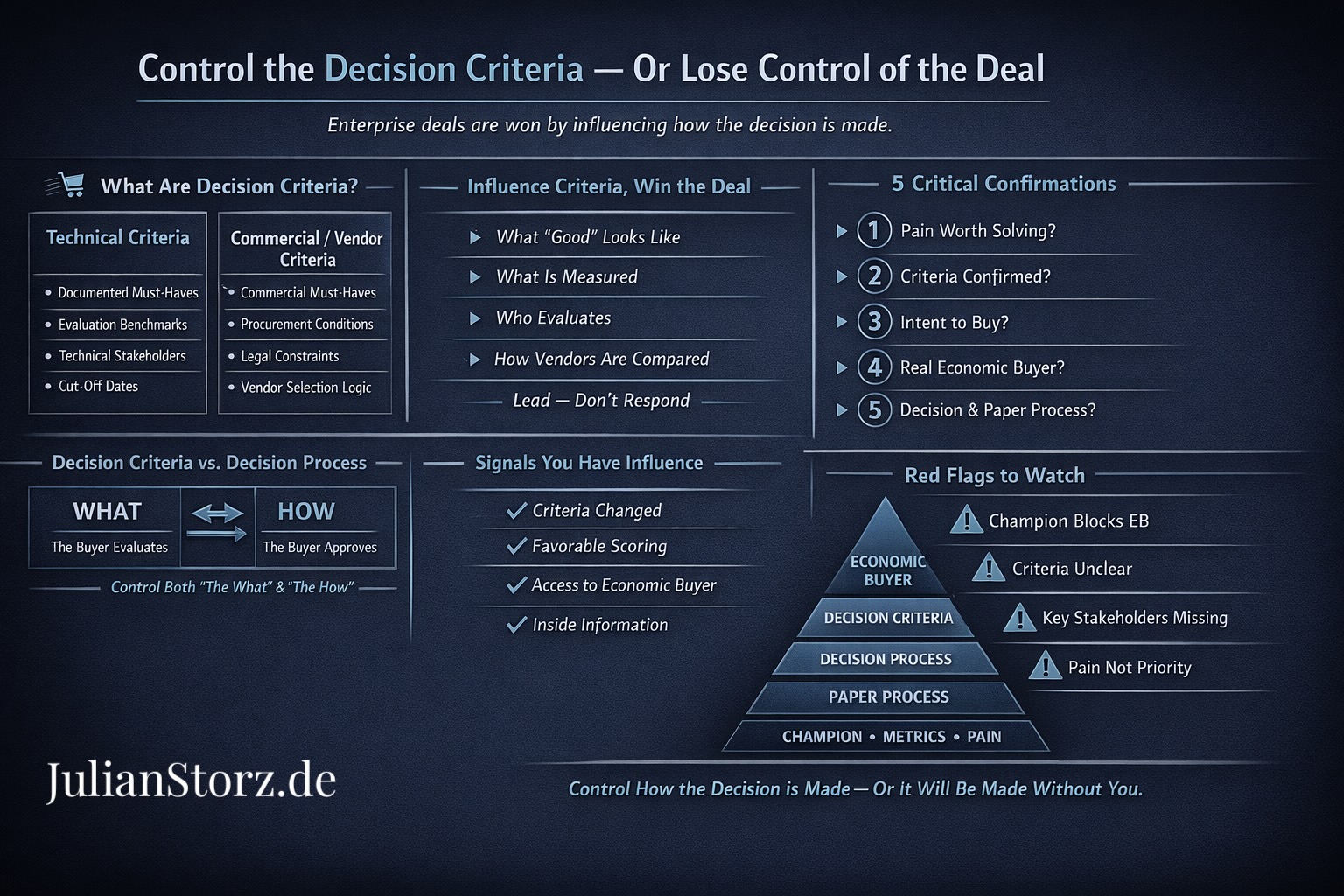
The reason for this shift is simple. Enterprise deals are not won by who presents best. They are won by who controls how the decision is made. In enterprise organizations, managers are hired to fulfill specific expectations set by the organization. As a result, they must justify their decisions to management and to other stakeholders who may have a formal or informal say in a purchasing decision—often because of their controlling or oversight functions. While most sellers still focus on decks, demos, and messaging, Economic Buyers operate very differently. They apply decision rules. Quietly. Systematically. Consistently. Often without ever showing you the list.
In other situations, the requirements for a decision have not yet been fully articulated across all stakeholders. That lack of clarity often leads to sudden surprises later in the process. That asymmetry explains why so many deals feel promising—and still get lost. This is also why it is your job as a top performer to uncover these criteria early and validate them with all relevant stakeholders.
Because of the relevance of Decision Criteria and their impact on a final decision, I have deliberately stayed away from RFPs throughout my professional career. In the rare cases where I would engage in one, I would only do so under a very clear premise: I must get access to all stakeholders involved in the final decision-making process. Only then you can re-qualify the Decision Criteria, understand their prioritization, and assess whether they have already been influenced by the competition in ways that materially reduce our odds of success.
Why Decision Criteria Matter
Ray Dalio describes a habit that separates high-quality decisions from reactive ones:
“Experience taught me how invaluable it is to reflect on and write down my decision-making criteria whenever I made a decision, so I got in the habit of doing that.”
— Principles, Ray Dalio
Economic Buyers behave this way by default. Many sales reps, in contrast, still rely on intuition, momentum, and hope. That mismatch is dangerous. If you do not understand how a customer decides, you cannot reliably influence what they decide. Jeffrey Pfeffer adds the political reality most sellers underestimate:
“There are limits to what you can do to affect the criteria used to judge your work. But you can highlight those dimensions of job performance that favor you—and work against your competition.”
— Power, Jeffrey Pfeffer
This is the real leverage point. You may not control whether Decision Criteria exist. But you can influence which dimensions matter most. Imagine a promotion process where the criteria are years served and political connections—not impact delivered. That is how most enterprise deals begin. Someone else already wrote the rules.
In enterprise sales, your goal is to deeply understand the customer’s challenges and—together with the customer—define the rules by which the purchasing decision will be made. It is perfectly fine if you cannot fulfill those expectations. In that case, you can qualify out and move on. But you will have saved yourself weeks—sometimes even months—of time that you would otherwise have invested, only to lose the deal at the very end.
What Decision Criteria Actually Are
Decision Criteria are the mutually agreed conditions that must be true for the customer to approve an investment.
They are not:
- feature lists
- RFP boilerplate
- Vendor scorecards
They are:
- outcome-anchored
- measurable
- defensible internally
- owned by specific stakeholders
A simple test question: What must be true for you to confidently say yes?
Strong sellers help customers answer that question clearly. The Challenger model describes this shift precisely:
“Present ROI of solving the problem… Talk about benefits, not features… Guide customers decisively into your solution.”
— The Challenger Sale, Matthew Dixon & Brent Adamson
In well-run enterprise deals, the feature list becomes an appendix. The real criteria live on the Economic Buyer’s performance dashboard—and they differ by role.
The Four Types of Decision Criteria
Enterprise deals never have a single set of criteria. They have four distinct types. Treating them as one list leads to blind spots—and late surprises.
Business Decision Criteria
Define why the company should invest now, anchored in revenue, risk, and strategic impact.
Technical Decision Criteria
Define what must work in the real environment to make the solution viable at scale.
Commercial / Vendor Criteria
Define how the solution is bought, priced, contracted, and risk-managed.
Political / Organizational Criteria
Define who wins, who loses, and who is accountable if the decision succeeds or fails.
Business Decision Criteria
Define why the company should invest now, anchored in revenue, risk, and strategic impact. Business Decision Criteria are owned by the Economic Buyer and answer one central question:
Why should the company invest in this now?
They emerge from quantified pain—not from IT or provider preferences. John McMahon describes the progression clearly:
“Found business pain creates opportunity… Business champions get you to the Economic Buyer. The Economic Buyer has access to major funds. You sell big deals based on value.”
— The Qualified Sales Leader, John McMahon
At senior levels, pain sharpens even further:
“At the highest levels of an organization, business pain is related to revenue, profitability, and risk.”
— The Qualified Sales Leader, John McMahon
This explains a common pattern: Economic Buyers disengage from technical discussions—until those discussions are translated into revenue impact, cost exposure, or strategic risk. If your Decision Criteria live only in technical language, you do not yet have business criteria.
Technical Decision Criteria
Define what must work in the real environment to make the solution viable at scale. Technical Decision Criteria are owned by Architects, Engineering, Security, and other technical or operational stakeholders. They determine whether a solution or approach can actually work. They are also the criteria most often weaponized.
From my own hard-earned experience:
- Know and influence the required capabilities of the solution
- Ensure the customer has a fully defined scope—and support them in closing gaps—Do not move forward until the scope is finalized
If you do not help define Technical Decision Criteria early, someone else will. And that “someone else” is often the incumbent or another seller who invests more deeply in the customer than you do. Late-stage technical constraints are rarely neutral. They are usually designed to preserve the status quo. Technical Decision Criteria must be negotiated early, not discovered late.
Commercial / Vendor Criteria
Define how the solution is bought, priced, contracted, and risk-managed. Commercial / Vendor Criteria are owned by Procurement and Finance. What is critical to understand is this: Procurement does not buy outcomes. Procurement buys risk reduction and price leverage. McMahon describes the move precisely:
“To gain pricing leverage, Procurement will essentially perform a virtual separation of the business side of the company from the procurement side… in an effort to commoditize your product.”
— The Qualified Sales Leader, John McMahon
When that separation succeeds, value disappears. Price becomes the dominant—and often the only—criterion. The counter-move is uncomfortable but necessary: re-anchor Commercial Criteria to business value, with the Economic Buyer involved.
This is where the political capital you have built throughout the sales process and account work truly matters.
Political / Organizational Criteria
Define who wins, who loses, and who is accountable if the decision succeeds or fails. These criteria are rarely written—but always decisive. They answer questions like:
- Who owns success?
- Who carries failure?
- Who is accountable if this goes wrong?
Remember: an Economic Buyer always needs a Champion to implement a solution, and that Champion usually relies on their team to deliver outcomes.
“As a CIO, I can’t implement the solution by myself… I need someone under me, whom I can hold accountable for a successful implementation.”
— The Qualified Sales Leader, John McMahon
That is an implicit Decision Criterion. If no one in the organization is willing to take accountability for success, no senior executive will take on the risk. Ownership must always sit at the operational level. Your Champions can help surface these dynamics—but only when trust exists:
“Once a sales rep finds a potential Champion, they have to earn that person’s trust… Good Champion-builders aren’t selfish. They’re selfless. They are authentic and curious.”
— The Qualified Sales Leader, John McMahon
A Champion will only fight for your criteria with the Economic Buyer and other executives if you are fighting for their credibility as much as for your own success.
When Decision Criteria Must Be Set
Decision Criteria follow a lifecycle. Ignoring it leads to drift.
| Phase | Status |
| Early Discovery | Hypothesized |
| Post-Discovery | Negotiated |
| Pre-Business Case | Locked |
| POV | Tested |
| Proposal | Immutable |
The rule that matters: If Decision Criteria change after the business case, the deal is already at risk.
“Ensure EB Access… if anyone decides to significantly change our agreed validation criteria.”
— The Qualified Sales Leader, John McMahon
Moving goalposts mid-POV is not collaboration—and certainly not partnership. In modern solution selling, deals are often only transactions. Achieving real value, especially from highly complex implementation projects or enterprise software, however, requires long-term partnerships. Those partnerships can only exist with alignment across all levels, transparent communication, and clear expectation-setting.
How Decision Criteria Are Created
There are only three modes.
Customer-defined criteria
Often RFP-driven and frequently incumbent-friendly due to existing relationships and legacy decision processes.
Vendor-influenced criteria
Co-created through discovery and anchored in customer language.
This is where enterprise deals are won.
Vendor-defined criteria
Rare and powerful. Requires reframing the problem itself.
This is Challenger territory:
“Offers customers unique perspectives… Identifies economic drivers… Takes control of the sale.”
— The Challenger Sale, Matthew Dixon & Brent Adamson
When you change how the problem is understood, you change what must be true to solve it. This is also why deep expertise matters. Only when you truly understand your domain can you educate customers on hidden connections and make previously invisible leverage points visible to them.
The Only Decision Criteria Format That Works
If criteria are vague, they are not decision-grade. Use this format—consistently:
Achieve […] under […] conditions to produce […] business outcome, validated by [role], measured by [metric], by [date].
No quantified outcome means no real business justification.
“You can’t express the value only in general terms… without adding a material measure or a quantified value.”
— The Qualified Sales Leader, John McMahon
Decision Criteria Drive POVs and Go / No-Go
A POV exists for one reason: to test pre-agreed Decision Criteria.
“Only perform a validation event after you have a confirmed Champion… framed validation criteria… built a cost justification… and verified next steps with the EB.”
— The Qualified Sales Leader, John McMahon
Skipping these steps does not accelerate deals. It turns sellers into unpaid consultants.
A Go / No-Go Meeting is where criteria become immutable. These meetings should take place after a joint workshop with the customer, where the problem has been framed and mapped to requirements. Those requirements must align with your unique value proposition. If they do not, say so clearly—and qualify out.
“A Go/No-Go Meeting… confirms the pain is a priority and that the POV plan directly correlates to the criteria.”
— The Qualified Sales Leader, John McMahon
Champion and Economic Buyer — Different Roles, Different Power
A real Champion:
- co-authors Decision Criteria
- socializes them internally
- defends them when you are not present
As I define it: “A Champion owns the pain, has power and influence with the Economic Buyer, and sells for you when you’re not there—because they want you to win as they understand the uniquely differentiated value you provide.”
The Economic Buyer sits above the decision, so if the Economic Buyer has not sanctioned the criteria, they are not real.:
“Above every decision maker sits VITO—the approver of the sale and everything else.”
— Selling to VITO, Anthony Parinello
Qualifying Decision Criteria
MEDDICC acts as a map throughout the sales process. It often follows this chain:
Pain → Champion → Competition → Decision Process → Economic Buyer Identified → Economic Buyer Accessed → Decision Criteria → Metrics → Paper Process
“MEDDICC should act as a map… showing where you are and any uncovered territory.”
— MEDDICC, Dick Dunkel & Jack Napoli
Uncovered territory late is not a to-do list. It is a qualification failure that introduces significant risk into your business and forecast.
Ask yourself:
- Are the criteria written in customer language?
- Are they measurable?
- Is each criterion owned by a stakeholder?
- Will all vendors be held to the same standards?
One “no” is a signal to pause, go back to the customer and qualify, not to push the sales process further and just live with the risk.
Using Decision Criteria to De-Risk a Deal
Decision Criteria expose risk early:
- Competitive risk: criteria favor competitors
- Political risk: misalignment with Economic Buyer priorities
- Execution risk: criteria cannot be tested
Sometimes the best decision is to qualify out. Walking away from a biased deal creates space for one that closes cleanly. That is not only good salesmanship—it is also good time management, and ultimately a better quality of life.
Final Thought
Neil Rackham warned us years ago:
“Closing techniques become less effective as decision size increases.”
— SPIN Selling, Neil Rackham
Challenger explains why:
“Reps add value through knowledge transfer, not persuasion.”
— The Challenger Sale, Matthew Dixon & Brent Adamson
Enterprise sales is not about closing harder. It is about engineering how decisions are made. Control the Decision Criteria, and you control the deal.